July 20, 2026
If you’ve started researching custom software, you’ve probably encountered a long list of software development terms: Laravel, .NET, React, APIs, cloud computing, microservices, SQL databases, and countless others. Before long, it can feel like you’re expected to become a software engineer just to make an informed decision.
Thankfully, you don’t need to understand the ins and outs of every technology. You just need to understand how the right technology choices support your organization’s goals.
Instead of starting with tech specs, start with the business problem that you are trying to solve.
Technology is only valuable when it helps your organization work more effectively, and the right framework can make software easier to maintain. A well-planned architecture can help your system grow alongside your organization. Choosing technologies that integrate with your existing systems can eliminate hours of manual work every week.
On the other hand, chasing the latest trend or selecting a technology simply because it’s popular can create unnecessary complexity, increase costs, and make future changes more difficult.
Whether you’re evaluating your first custom software project or planning to modernize an existing system, understanding how development teams make technology decisions will help you ask better questions and feel more confident throughout the process.
This guide explains the technologies you’ll commonly encounter, how experienced software teams evaluate them, and what choosing the “best” technology really looks like.
Key Takeaways
- There is no universally “best” software development technology—every project involves tradeoffs.
- Business goals, workflows, and long-term maintenance should drive technology decisions.
- A technology stack includes much more than a programming language. Frameworks, databases, cloud platforms, and integrations all play important roles.
- Experienced development teams evaluate scalability, security, maintainability, and integration needs before recommending a solution.
- Popular technologies aren’t always the right choice. Mature, well-supported technologies also deliver long-term value.
- The best software decisions focus on solving operational challenges rather than following industry trends.
What Are Custom Software Development Technologies?
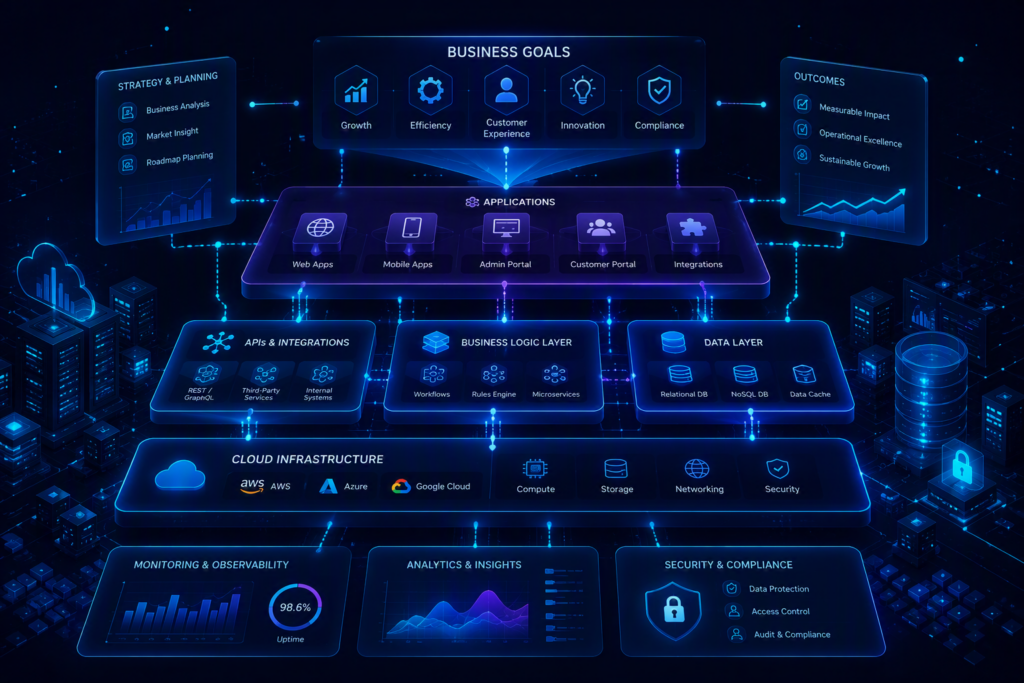
“Custom software development technologies” is an umbrella term for the tools developers use to design, build, deploy, and maintain software. Think of them as the materials and equipment used to construct a building. You wouldn’t evaluate a building based solely on the type of hammer the contractor used, and the same principle applies to software.
Instead, successful software depends on how all of the pieces work together.
Programming Languages
Programming languages are what developers use to write software. Each language has its own strengths, and different languages are better suited to different types of applications.
For example, C# is commonly used for enterprise applications built on Microsoft’s .NET platform, while PHP powers many modern web applications, including those built with Laravel.
For most businesses, however, the specific language isn’t the most important decision. A capable development team can build excellent software using several different languages. What’s more important is selecting technologies that align with your project’s goals and long-term maintenance needs.
Frameworks
If programming languages are the vocabulary developers use, frameworks provide the structure.
A framework is a collection of pre-built tools, conventions, and components that allow developers to build software more efficiently without reinventing common functionality every time they start a project.
Laravel, for example, provides features for user authentication, security, routing, database management, and testing. Rather than building each of these systems from scratch, developers can focus on solving the unique challenges your organization faces.
Well-established frameworks also improve consistency and maintainability. Because they follow common patterns, future developers can more easily understand and extend the software.
Databases
Nearly every business application relies on a database.
Whether you’re managing customer records, applications, financial transactions, inventory, or reporting data, a database stores and organizes the information that keeps your software running.
Different databases are optimized for different workloads, but from a business perspective, the most important considerations are reliability, performance, security, and scalability.
A well-designed database often has a greater impact on day-to-day performance than the programming language used to build the application itself.
Front-End Technologies
When people think about software, they’re usually thinking about the user interface: the screens employees interact with every day. Front-end technologies determine how those interfaces look and behave.
Modern frameworks like React and Vue help developers create responsive, interactive experiences that feel fast and intuitive, even when they’re performing complex tasks behind the scenes.
This is especially important because even the most powerful software has limited value if employees find it difficult to use.
APIs and Integrations
Few organizations operate with a single software platform. Instead, they rely on accounting software, CRM systems, HR platforms, payment processors, reporting tools, document management systems, and countless other applications.
Application programming interfaces (APIs) allow these systems to communicate with one another.
Instead of employees manually copying information between systems, APIs automate those exchanges, reducing duplicate work and minimizing opportunities for human error.
For many organizations, integrations create more value than adding entirely new functionality.
Cloud Platforms and Infrastructure
Once software has been developed, it needs somewhere to run.
Cloud platforms such as Microsoft Azure and Amazon Web Services (AWS) provide the infrastructure that hosts applications, stores data, and supports ongoing growth.
Cloud infrastructure offers advantages such as:
- Flexible scalability as usage grows
- Improved reliability through redundant systems
- Built-in security capabilities
- Simplified maintenance and updates
Not every application belongs in the cloud, but modern cloud platforms give organizations more flexibility than traditional on-premises infrastructure alone.
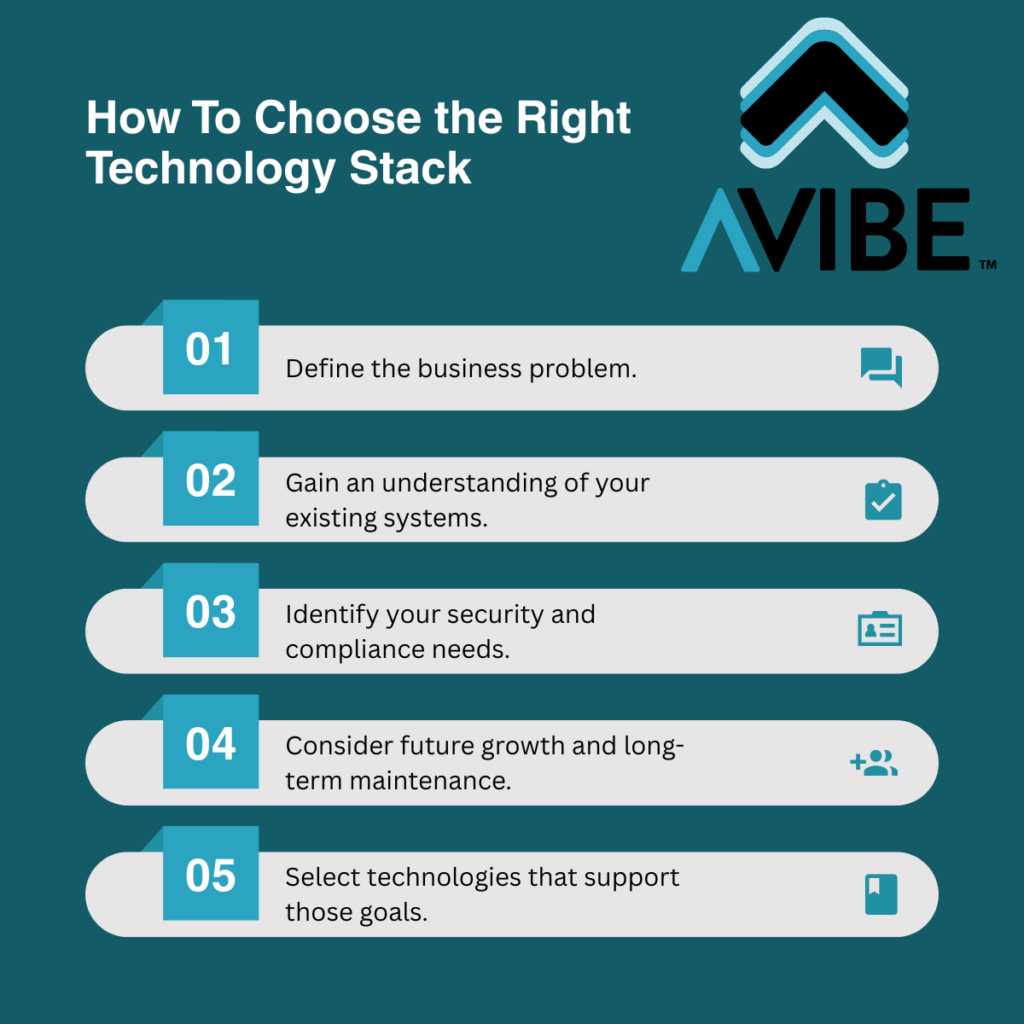
Questions To Ask Before Choosing a Tech Stack
The right technology stack begins with the right questions.
Before discussing programming languages or frameworks, decision makers should determine what they want success to look like.
Before evaluating technologies, ask questions like:
- What operational problem are we trying to solve?
- Which existing systems will this software need to integrate with?
- How many people will use it today and how might that change over the next five years?
- Are there compliance or security requirements that influence our options?
- Who will maintain this software over time?
- How frequently do we expect the application to evolve?
- Is reducing manual work our biggest priority, or are we focused on improving visibility, customer experience, or scalability?
- Are we replacing an existing system, modernizing it, or building something entirely new?
Notice that none of these focus on which programming language is best. The answers to these business questions naturally shape the technical recommendations that follow.
A good development partner helps uncover those requirements through discovery and collaborative planning. By understanding your workflows, constraints, and long-term goals first, they can recommend technologies that fit your organization rather than asking your organization to fit the technology.
How Development Teams Actually Choose Technologies
One of the biggest misconceptions about software development is that experienced developers have a favorite technology they recommend for every project.
In reality, the opposite is true. An experienced software development team will spend far more time understanding the problem than selecting the technology.
In many ways, choosing a technology stack resembles hiring employees. You wouldn’t hire someone simply because they have an impressive résumé. You’d evaluate whether their skills match the role, how they’ll collaborate with your team, and whether they’re likely to succeed over the long term.
Technology decisions follow a similar process.
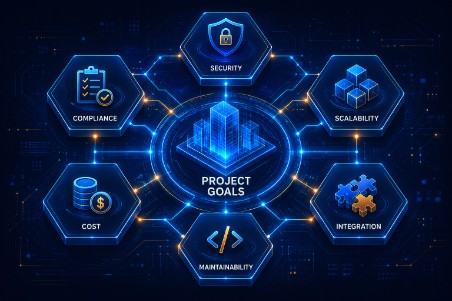
Business Requirements Come First
Every software project starts with a business objective. That objective might be reducing manual work, replacing outdated software, improving reporting, integrating disconnected systems, or supporting team growth.
These goals should be clear before development begins.
This is one reason discovery is such an important phase of custom software development. It helps ensure that technical decisions are grounded in operational realities rather than assumptions.
In AVIBE’s discovery workshops, we often spend more time exploring frustrations like duplicate data entry or reporting inefficiencies than exploring a fully formed technical vision. Those conversations are what shape technology recommendations.
Existing Systems Matter More Than Many People Realize
Most businesses already rely on multiple software systems that support accounting, customer management, compliance, document storage, communications, or industry-specific operations.
New software needs to work alongside those existing systems, or gradually replace them without disrupting day-to-day operations.
For example, an organization heavily invested in Microsoft’s ecosystem may benefit from technologies that integrate naturally with Azure, Active Directory, and SQL Server. Another organization might prioritize compatibility with existing PHP applications or legacy systems.
Ignoring existing infrastructure can significantly increase both project complexity and long-term costs. In our experience, connecting existing systems through well-designed APIs delivers faster results with less disruption. Modernization doesn’t always mean starting over.
Scalability Is About More Than Growth
When people hear the word “scalable,” they often think exclusively about serving more users.
While that’s certainly part of scalability, experienced development teams think more broadly.
- Can the software support new business processes?
- Can additional features be added without major redesigns?
- Will new departments be able to use it?
- Can reporting evolve alongside organizational needs?
A scalable system isn’t simply one that handles more traffic. It’s one that can adapt as the organization changes.
Security and Compliance Shape Technical Decisions
Organizations operating in regulated industries often have security requirements that influence technology choices from the very beginning.
Authentication methods, data storage practices, audit logging, encryption standards, user permissions, and hosting environments all play important roles.
Rather than treating security as a feature that gets added later, experienced development teams build it into architectural decisions from the outset.
Doing so helps reduce risk while making future compliance efforts significantly easier.
Long-Term Maintenance Should Never Be an Afterthought
Launching software is only the beginning of its lifecycle.
Over the years, requirements change. Regulations evolve. Employees come and go. New integrations become necessary.
The technologies selected today should still be practical to maintain years from now.
A sustainable technology choice isn’t necessarily the newest one. It’s the one that gives your organization confidence that the software can continue evolving alongside your business.
Experienced Teams Evaluate Tradeoffs, Not Winners
One framework might allow faster development. Another may integrate more naturally with existing infrastructure. One database may excel at handling massive amounts of data, while another offers simpler administration.
Good software development is about making thoughtful decisions based on your organization’s goals, constraints, and future plans. The technical decision will follow from there.
Common Technologies You’ll Encounter
You don’t need to memorize every programming language or framework to make informed decisions about custom software. Still, understanding the role each technology plays can make conversations with development teams much more productive.
Think of these technologies like tools in a workshop. A skilled craftsperson doesn’t use the same tool for every project: they choose the one that best fits the job. Experienced custom development partners take the same approach.
Laravel: Building Modern Web Applications Quickly and Reliably
Laravel is one of the world’s most widely used PHP frameworks, and for good reason. It gives developers a mature, well-organized foundation for building secure, scalable web applications without reinventing common functionality from scratch.
For the people using the software, that translates into several practical benefits:
- Faster development timelines
- Strong security features
- Easier long-term maintenance
- A large developer community and ecosystem
Laravel is particularly well suited for custom business applications, customer portals, internal operational systems, and platforms that require ongoing enhancements over time.

Laravel encourages developers to follow consistent development practices. That makes future updates easier, not just for the original development team, but for anyone who maintains the application years later. It has become one of our preferred frameworks because it balances rapid development with long-term maintainability. However, it’s not the right choice for every project.
.NET: A Strong Choice for Enterprise Applications

Microsoft’s .NET platform has long been a staple of enterprise software development.
Organizations already invested in Microsoft technologies often find that .NET integrates naturally with products like Azure, SQL Server, Active Directory, and Microsoft 365.
That doesn’t automatically make it the right choice, but it does make it an attractive option when businesses want to build on infrastructure they already know and trust.
.NET is commonly used for:
- Enterprise applications
- Internal business systems
- Government software
- Healthcare platforms
- Financial systems
Like Laravel, .NET benefits from a mature ecosystem and long-term support from a major technology company.
The choice between Laravel and .NET rarely comes down to which framework is “better.” Instead, it depends on existing systems, organizational priorities, and the specific requirements of the project.
Front-End Frameworks: The Software Your Team Recognizes
When people talk about software being “easy to use,” they’re usually talking about the front end.
Frameworks like React and Vue help developers build responsive, intuitive interfaces that feel modern and perform well across devices.
To most users, the technology behind their software matters less than how intuitive it is.
A thoughtful user experience can reduce training time, improve adoption, and help employees complete everyday tasks more efficiently.
Technology supports usability, but good design ultimately determines whether people enjoy using the software.
Databases: The Foundation Behind Every Business Application
Every business application depends on data.
Customer information, financial records, inventory, documents, reports, and operational workflows all rely on a database that stores and organizes information reliably.
Popular relational databases include PostgreSQL, Microsoft SQL Server, and MySQL.
Although each has technical differences, decision-makers generally care about broader questions:
- Can it securely store our data?
- Will it perform well as we grow?
- Can it support reporting?
- Will it integrate with our other systems?
A well-designed database often determines whether software feels fast and dependable years after launch.
APIs: Helping Software Work Together
Very few organizations want another isolated application.
Instead, they want software that connects existing systems and reduces manual work.
This is where APIs become invaluable.
An API allows separate applications to exchange information automatically.
Instead of exporting spreadsheets every Friday or copying customer records between systems, integrations can synchronize that information continuously.
These connections often create some of the biggest efficiency gains in custom software because they eliminate repetitive work rather than simply digitizing it.
Cloud Platforms: Supporting Growth Without Rebuilding
Today’s custom software often runs on cloud platforms like Microsoft Azure or Amazon Web Services (AWS).
Cloud hosting offers flexibility that traditional infrastructure can’t always provide.
As organizations grow, cloud environments can often expand alongside them without requiring significant hardware investments. Cloud platforms also provide services that improve reliability, backup, monitoring, and disaster recovery.
Whether you’re choosing a cloud platform, framework, or database, the same principle applies: the right choice depends on your organization’s goals.
Why the “Best” Technology Usually Doesn’t Exist
One of the most common questions organizations ask is:
“What’s the best framework for custom software?”
Now imagine asking an architect whether steel or wood is the better building material: the answer depends entirely on what they are building.
Software development works the same way.
This is one reason experienced development teams spend so much time asking questions during discovery. They’re gathering the information needed to evaluate those tradeoffs thoughtfully rather than applying the same technical recipe to every project.
Technology Trends That Matter
Technology evolves rapidly. Every year brings new frameworks, programming languages, and industry buzzwords promising to change software development forever.
Some of those innovations genuinely improve the software and user experience, while others generate far more excitement than practical value.
Knowing the difference allows decision-makers to be more confident in their choices.
Artificial Intelligence
AI is rapidly becoming a practical business tool. It’s not because every application needs a chatbot, but because machine learning can automate repetitive tasks, improve search capabilities, summarize information, and support better decision-making.
The important question isn’t whether AI should be included, but rather how it can best be used to solve business problems.

Automation
Organizations continue looking for ways to eliminate repetitive manual work.
Whether that involves workflow automation, document processing, notifications, or integrations between systems, automation often delivers measurable operational improvements.
Unlike many technology trends, automation produces benefits that employees experience almost immediately.
Cloud-Native Infrastructure
Modern cloud platforms allow organizations to scale more efficiently, recover more quickly from failures, and deploy updates with less disruption.
Cloud-native doesn’t automatically mean “better,” but it has become an important consideration for many new software projects.
Trends Worth Approaching Carefully
Chasing the Newest Framework
A framework doesn’t become the right choice simply because it’s getting a lot of buzz.
Mature technologies often have years of documentation, community support, security improvements, and proven reliability behind them.
Building for Hypothetical Future Problems
It’s tempting to design software for every possible future scenario. In practice, though, this often creates unnecessary complexity.
Experienced development teams design for realistic growth while leaving room to adapt over time. Planning is valuable, but overengineering rarely is.
Treating Technology as a Competitive Advantage by Itself
Organizations occasionally become convinced that adopting a particular technology will transform their business.
In reality, competitive advantage usually comes from better processes, stronger customer experiences, and more efficient operations.
Technology enables those outcomes, but it needs to fit your business to work. If you’re not sure how to make that decision, that’s completely normal. A strategy workshop helps identify the right technology approach before development begins.
How the Right Technology Supports Better Business Outcomes
By now, you’ve probably noticed a pattern.
Every discussion about programming languages, frameworks, databases, and cloud platforms eventually circles back to the same question: How will this help our organization work better?
That’s because technology decisions are never just technical decisions. They influence how your employees do their jobs, how easily your systems communicate, how quickly your organization can adapt to change, and how much effort it takes to maintain your software over time.
The right technology choices create benefits that extend far beyond the IT department.
Better Software Fits the Way Your Organization Already Works
Many organizations begin exploring custom software because they’ve reached the limits of an off-the-shelf platform. Custom software offers an opportunity to reverse that relationship.
Instead of asking your people to adapt to someone else’s software, custom development allows technology to support the way your organization actually operates.
That doesn’t mean every existing process should remain unchanged. A thoughtful discovery process often uncovers opportunities to simplify workflows or eliminate unnecessary steps altogether. The goal of this process is to ensure the technology reflects the realities of your business instead of forcing your team into awkward compromises.
Maintainability Is an Investment in Your Future
Software should evolve as your business does. As a result, it’s best to treat it as an investment rather than a one-time purchase.
New regulations emerge. Departments grow. Priorities shift. The technology decisions made during development affect how easily your software can evolve to meet those changing needs.
Maintainable software is easier to update, easier to troubleshoot, and easier for future developers to understand. That reduces both the cost and the risk of making changes years after launch.
This is one reason experienced development teams often recommend mature, well-supported technologies. They offer proven ecosystems, strong documentation, and long-term stability.
Good Technology Decisions Reduce Operational Friction
The best software often goes unnoticed.
Employees aren’t talking about the framework it was built with or the database running behind the scenes. They’re simply getting their work done with fewer interruptions.
Reports that once took hours are available in minutes, while approvals move automatically from one person to the next. Managers have real-time visibility instead of waiting for someone to compile a spreadsheet.
These improvements may seem small individually, but together they can have a meaningful impact on productivity, decision-making, and employee satisfaction.
That’s why successful software projects focus on operational outcomes first and technical implementation second. After working with organizations across a variety of industries, we’ve found that successful software projects have one thing in common: they begin with understanding the business.
Technology Should Give You Flexibility, Not Lock You In
Organizations change.
Growth creates new requirements. Strategic priorities evolve. New regulations emerge. Acquisitions introduce additional systems. Customer expectations shift.
Your software should be able to evolve alongside those changes.
Choosing the right technology stack isn’t about predicting every future need perfectly. It’s about building a foundation that can adapt without requiring a complete rebuild every few years.
Flexibility comes from thoughtful architecture, maintainable code, and technologies that are widely supported, not from chasing every new trend that enters the market.
Technology Is Only Part of the Equation
Choosing the right technologies for a custom software project matters, but successful projects aren’t built on frameworks alone. They’re built on a clear understanding of the people who will use the software, the processes it needs to support, and the challenges it’s meant to solve.
That’s why the best technology decisions rarely start with questions like, “Should we use Laravel or .NET?” They start with questions like, “Where are our biggest operational bottlenecks?” or “What’s preventing our team from working more efficiently?”
Once those answers are clear, the right technologies often become much easier to identify.
At AVIBE, that’s exactly how we approach every project. Before we recommend a programming language, framework, or architecture, we take the time to understand how your organization works today, where friction exists, and what success looks like for your team. Sometimes that leads to a modern Laravel application. Sometimes it means extending or modernizing an existing ColdFusion system. Other times, it may reveal that custom software isn’t the right solution at all.
Our goal isn’t to sell you a particular technology. It’s to help you make a decision you can feel confident about: one that supports your organization today and continues to deliver value as your needs evolve.
If you’re exploring a custom software project or wondering whether your current systems are still serving your organization well, we’d be happy to start with a conversation. Together, we can evaluate your goals, discuss your options, and determine the technology approach that makes the most sense for your business.
Ready to explore what’s possible? Contact AVIBE to schedule a discovery conversation, and let’s talk about how technology can help your organization work smarter, not harder.
Frequently Asked Questions
What are custom software development technologies?
Custom software development technologies are the programming languages, frameworks, databases, cloud platforms, and other tools developers use to build software tailored to an organization’s specific needs. Together, these technologies form the foundation of a software application.
What is a technology stack?
A technology stack is the combination of technologies used to build and run a software application. It typically includes front-end technologies, back-end frameworks, databases, hosting infrastructure, and integration tools.
Does the programming language matter?
Yes, but usually less than people think.
For most organizations, choosing technologies that align with business goals, existing systems, long-term maintenance, and security requirements is more important than selecting a specific programming language.
What’s the difference between a programming language and a framework?
A programming language provides the syntax developers use to write software.
A framework provides a structured foundation with pre-built functionality that helps developers build applications more efficiently and consistently.
Think of the programming language as the raw materials and the framework as the blueprint that organizes them.
Is Laravel a good choice for business applications?
Laravel is widely used for custom web applications because it offers strong security features, rapid development capabilities, and excellent long-term maintainability.
Whether it’s the right choice depends on your organization’s requirements, existing systems, and long-term goals.
Is .NET better than Laravel?
Organizations already invested in Microsoft’s ecosystem often lean toward .NET, while Laravel is frequently a strong choice for custom web applications that prioritize rapid development and maintainability.
Can older technologies still be the right choice?
Absolutely.
Many legacy technologies continue supporting critical business operations successfully.
In some cases, modernizing an existing application gradually is more practical and less disruptive than replacing it entirely. The right approach depends on factors such as maintainability, security, business risk, and future needs.
How long should a technology stack last?
A well-designed technology stack should support an organization for many years.
While individual components may be updated over time, maintainable software can often evolve incrementally without requiring complete replacement.
How do I know if my organization needs custom software?
Custom software may be worth considering if your organization:
- Relies heavily on manual processes
- Uses several systems that don’t communicate with one another
- Has outgrown off-the-shelf software
- Requires workflows that commercial software can’t adequately support
- Needs specialized reporting, compliance features, or integrations
Not every challenge requires custom software, but when operational complexity begins creating friction across your organization, it may be time to explore whether a tailored solution makes sense.
How do development teams decide which technologies to recommend?
Experienced development teams begin by understanding your business objectives, existing systems, operational challenges, security requirements, and long-term goals.
Helpful Web Tips & Tricks
Start Your Project