September 10, 2026
If your organization still relies on a ColdFusion application, you’re not alone.
Many businesses continue to depend on ColdFusion-powered systems that manage operations, customer interactions, reporting, inventory, compliance workflows, and other critical business functions. In many cases, these applications have been refined over years or even decades and continue to deliver meaningful value.
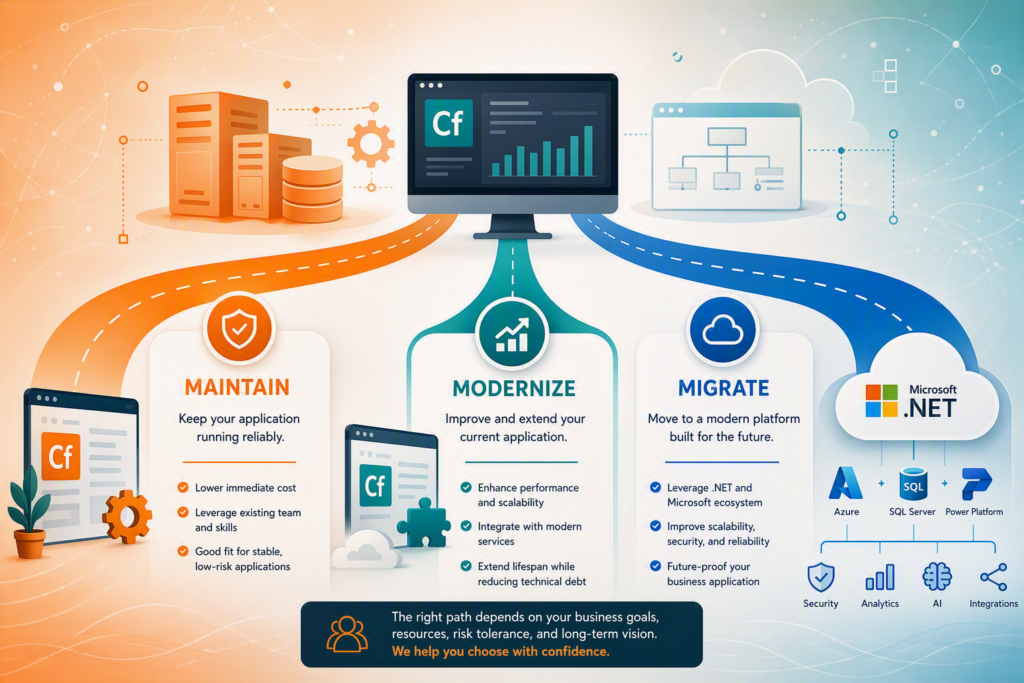
But eventually the same question tends to come up: should we stay on ColdFusion, modernize what we have, or migrate to .NET?
For some organizations, migrating to .NET aligns with long-term business and technology goals. For others, modernization or ongoing maintenance may deliver better results with less risk and disruption.
The challenge has less to do with choosing a technology and much more to do with which path best supports your business.
Key Takeaways
A ColdFusion to .NET migration may make sense when:
- Your organization has standardized on Microsoft technologies
- The application’s architecture is limiting growth or scalability
- Future hiring and talent availability are major concerns
- Business requirements have changed significantly
- Long-term platform consolidation is a strategic priority
At the same time:
- Migration is not automatically the best option simply because an application is old.
- Many ColdFusion applications continue to deliver value through upgrades, maintenance, or targeted modernization efforts.
- Modernization can often address performance, security, and usability challenges without a complete rewrite.
Why Organizations Consider Moving from ColdFusion to .NET
Migration conversations are often connected to broader business initiatives, organizational changes, or long-term planning efforts.
Microsoft Ecosystem Alignment
One of the most common reasons organizations evaluate .NET is because they already operate within the Microsoft ecosystem.
When a company already relies heavily on Azure, Active Directory, Microsoft SQL Server, Power Platform, or Microsoft 365, moving to .NET can create greater platform consistency and simplify long-term management.
The discussion often becomes less about replacing ColdFusion and more about reducing complexity across the technology stack.

Long-Term Staffing and Support Concerns
Another common driver is continuity planning. A surprising number of ColdFusion applications support critical business functions while relying on knowledge held by a fairly small number of people. That doesn’t create an immediate problem, but it does create questions about future support, hiring, and succession planning.
For some, moving to .NET is part of a broader effort to ensure long-term continuity and reduce dependency on specialized institutional knowledge.
Significant Changes to the Business
Migration discussions also tend to surface when the business is already making changes.
A company may be redesigning its customer portal, replacing an ERP system, expanding into new markets, or rethinking internal workflows. Once those conversations start, teams naturally begin evaluating whether the existing application platform still fits where the business is headed.
In these situations, migration is less about replacing ColdFusion and more about taking advantage of a larger transformation initiative.
When Staying on ColdFusion is the Best Option
One of the biggest misconceptions in legacy software is that age automatically means replacement.
We’ve worked with a lot of ColdFusion applications over the years. Sometimes businesses come to us to evaluate migration options, only to discover that a targeted modernization initiative would accomplish the same business goals at a lower cost and with less disruption.
A ColdFusion application may still be a strong candidate for continued investment when:
- The application is stable
- Core business workflows remain effective
- Users are satisfied
- Security concerns can be addressed
- Performance issues are manageable
- Business requirements have not fundamentally changed
Sometimes the best technology decision you can make is improving what already works.
What a ColdFusion-to-.NET Migration Actually Involves
It may seem unintuitive, but the most successful migrations focus on business functionality first and technology second.
Discovery and Assessment
Before development begins, teams need to understand:
- Business workflows
- Application dependencies
- Integrations
- Data requirements
- Documentation gaps
- Hidden business logic
This phase often uncovers functionality that users depend on but nobody has formally documented. It also ensures that what is currently working well gets carried over, while what isn’t working gets improved.
Migration Planning
Once the current environment is understood, organizations can evaluate:
- Whether .NET is the right destination
- Whether migrations should occur in phases
- Technical risks and dependencies
- User adoption concerns
- Budget and timeline considerations
Incremental Development
Once a migration strategy is established, development can begin. While some organizations choose a single cutover approach, many reduce risk by migrating functionality in stages. This allows teams to prioritize the highest-value areas of the application first, gather feedback throughout the process, and validate assumptions before moving on to the next phase.
A phased approach can also help minimize business disruption. Rather than replacing a business-critical application all at once, organizations can introduce changes incrementally while maintaining continuity for users and operational teams.
Validation and Testing
A successful migration is measured by whether the application continues supporting the business as expected. Throughout the migration process, teams should validate workflows, integrations, reporting, data accuracy, security controls, and user experiences to ensure critical functionality is preserved. This testing often involves both technical stakeholders and the employees who use the system every day.
The overall goal is to ensure the new platform supports current business requirements while providing a stronger foundation for future growth, maintenance, and enhancements.
Considering Migrating from ColdFusion to .NET?
A move to .NET can make sense for the right application. Whether it’s to align with existing Microsoft investments, support broader technology initiatives, or address architectural limitations, there are many reasons businesses would choose to migrate.
At the same time, not every aging ColdFusion application needs to be rewritten. In many cases, maintenance, upgrades, or targeted modernization efforts can address the underlying challenges without the cost, complexity, and disruption of a full migration.
The challenge is determining which path makes the most sense for your application, your team, and your business goals.
AVIBE has helped organizations maintain, modernize, and migrate ColdFusion applications since 2005. As an Adobe ColdFusion Solution Partner, we understand the capabilities and limitations of the platform, as well as the practical realities of migrating to technologies such as .NET. Whether you’re evaluating a migration, exploring modernization opportunities, or simply trying to understand the condition of your current application, our team can help you assess your options and build a roadmap based on your unique needs.
Schedule a consultation to discuss your technology and explore the best path forward.
Frequently Asked Questions
Is .NET better than ColdFusion?
Not necessarily. Both technologies can effectively support business-critical applications. The better question is whether .NET aligns more closely with your organization’s long-term goals, technical requirements, and internal capabilities. In some cases, modernization may provide more value than migration.
How long does a ColdFusion-to-.NET migration take?
There isn’t a standard timeline. The complexity of the application, number of integrations, documentation quality, data requirements, and project scope all affect how long a migration will take. A discovery and assessment phase is the best place to start and allows developers and project managers to provide an informed estimate of project length.
Can a ColdFusion application be migrated in phases?
Yes. Many organizations choose to migrate functionality incrementally rather than replacing everything at once. A phased approach can reduce risk, simplify testing, and allow business operations to continue while modernization efforts are underway.
Should I modernize or migrate?
It depends on the application’s condition and the problems you’re trying to solve. If the application still meets business needs and the primary concerns are security, performance, integrations, or maintenance, modernization may be more practical. Migration might be the better choice when broader changes or strategic factors are involved.
Helpful Web Tips & Tricks
Start Your Project