August 12, 2026
Adobe released another security update for ColdFusion on August 11, 2026. The Priority 1 update addresses 15 security vulnerabilities, including critical flaws that could lead to arbitrary code execution and application denial-of-service. Adobe is not currently aware of any exploits in the wild for these issues.
Critical security updates are a fact of life for every software platform. What varies from organization to organization is how quickly and confidently they can respond.
Some teams can evaluate, test, and deploy an update across multiple environments in a matter of days. Others find themselves slowing down to assess unknown dependencies, validate critical workflows, and understand how a change might affect the application.
Those differences are often years in the making. They reflect the state of the application, the maturity of the deployment process, and the investments an organization has made in maintaining the system over time.
Adobe’s latest ColdFusion update offers a useful reminder of just how important a mature testing and deployment process can be.
Every Security Update Is Really a Readiness Test
For organizations with mature development and deployment practices, applying a security update is often a structured and predictable process. They have environments for testing, established deployment procedures, and confidence that critical business functions can be validated before changes reach production.
For others, the process is far less certain.
ColdFusion applications frequently support important business functions, integrations, and internal workflows that have evolved over many years. When test coverage is limited or environments don’t accurately reflect production, it becomes difficult to predict how an update might affect the system.
That uncertainty can create a difficult tradeoff: delay a critical security update or move forward without adequate validation.
How AVIBE Reduces the Risk
Confidence comes from having a process that allows updates to be tested before they affect operations.
When a new ColdFusion update becomes available, our team begins working with it immediately. Developers apply the update in local development environments while continuing to build features, resolve issues, and test application functionality. This creates an early opportunity to identify compatibility concerns before the update moves into the next environment.
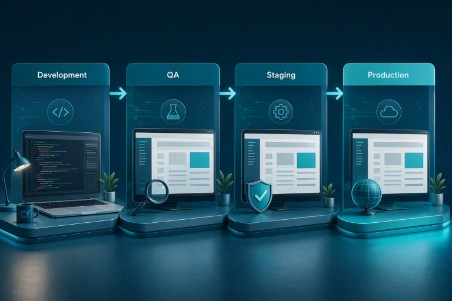
From there, the update moves through a structured series of environments:
Development → QA → Staging → Production
Each stage provides additional validation, helping transform a security update from a high-stakes event to a routine operational process.
Testing Beyond the Application
In our QA environments, we focus on validating the underlying platform functionality that applications depend upon.
Automated regression testing helps us identify issues that may affect platform functionality and application services, such as:
- PDF generation
- Email delivery
- File and document processing
- Authentication workflows
- Third-party integrations
- Session management and security controls
Repeated regression tests help us uncover unexpected behavior early.
In staging, we shift our attention to the application itself and answer more practical questions:
- Can users still log in?
- Can they complete key business processes?
- Do critical integrations continue working?
- Can employees and customers perform the tasks they rely on every day?
Together, these testing layers help identify issues before they reach production and provide greater assurance that critical business functions will continue to operate as expected.
Why Legacy Applications Often Struggle
The organizations that struggle most with critical security updates aren’t necessarily neglecting security. More often, they’re constrained by the application itself.
Many legacy systems were built before modern deployment practices became standard. They may contain:
- Hard-coded configuration values
- Environment-specific dependencies
- Production-only integrations
- Manual deployment requirements
- Limited test coverage
- Knowledge that exists primarily in the minds of a few individuals
Over time, these challenges can turn routine maintenance into a high-risk event, where even a necessary security update feels difficult to evaluate, test, and deploy.
ColdFusion Security Updates as a Modernization Opportunity
If applying a patch feels risky, the underlying problem may be the application environment or the processes around it rather than the vulnerability itself.
Security updates frequently expose issues that have existed for years: inconsistent environments, undocumented dependencies, manual deployment processes, limited testing capabilities, or application architectures that have become increasingly difficult to support. The update reveals those weaknesses.

At AVIBE, when we take responsibility for a legacy ColdFusion application, we don’t just learn the source code. We work to understand how the application operates, what it depends on, where its risks are, and what needs to change so the application can be managed safely.
That often includes improving environment consistency, reducing deployment risk, documenting dependencies, and creating testing processes that make future updates easier to evaluate and deploy.
Our goal is to create an application environment that can be maintained, supported, and evolved with greater predictability over time.
When those foundations are in place, security updates become far less disruptive. Teams can evaluate changes, validate functionality, and move updates through the deployment process without treating production as the testing environment.
How Quickly Could You Respond?
Adobe’s latest ColdFusion security update provides a useful opportunity for organizations to evaluate their readiness.
If a critical update were released today, could your team:
- Apply it in a non-production environment immediately?
- Validate the functionality most likely to be affected?
- Deploy it to a staging environment?
- Verify critical business workflows?
- Move it into production with confidence?
Preparing for the Next Update Starts Today
The goal isn’t simply to respond to the latest security update. It’s to build an application environment that makes the next one easier to evaluate, test, and deploy.
At AVIBE, we help organizations support, stabilize, and modernize legacy ColdFusion applications through ongoing maintenance, modernization initiatives, and application support services. Our team works with organizations that need to reduce operational risk, improve deployment confidence, and extend the life of business-critical ColdFusion applications.
If critical ColdFusion updates consistently feel difficult to evaluate, test, or deploy, we’d be happy to discuss your environment and help identify practical steps toward a more predictable support and deployment process.
Helpful Web Tips & Tricks
Start Your Project